Commentary: Language Learning Needs Better Writing
A case for moving beyond generic example sentences and dialogues, and bringing literary depth into Mandarin language learning.
Vocabulary-based example sentences teach you how words behave and how to use them in sentences. What they rarely give you is anything to care about while reading. What do I mean by that?
If you’re learning Chinese through traditional courses, you’ll find no shortage of generic study materials, produced by everyone from large educational institutions to independent teachers on social media. With AI, hundreds, if not thousands, of additional learning resources are now being produced. Unfortunately, most follow the same underlying pedagogical principles, giving us more of the same rather than something genuinely better.
To illustrate, even some of the better-crafted vocabulary-based example sentences look something like this:
10 HSK Vocabulary-Based Example Sentences
Example sentences for HSK 3.0 Level 3 Vocabulary Words 1–10: āyí (阿姨), àiren (爱人), bānjí (班级), bànfǎ (办法), bàngōngshì (办公室), bàozhǐ (报纸), běi (北), běifāng (北方), bǐjì (笔记), bǐjìběn (笔记本).
10
1
Wáng āyí shì wǒ de línjū, tā rén hěn hǎo.
王阿姨是我的邻居,她人很好。
Auntie Wang is my neighbor; she is a very kind person.
I just went to the office to look for you, but you weren’t there.
6
Wǒ bàba xíguàn měitiān zǎoshang kàn bàozhǐ.
我爸爸习惯每天早上看报纸。
My father has a habit of reading the newspaper every morning.
7
Huǒchēzhàn de běibiān yǒu yī gè hěn dà de bīnguǎn.
火车站的北边有一个很大的宾馆。
There is a large hotel to the north of the train station.
8
Wǒ chūshēng zài Zhōngguó běifāng de yī gè xiǎo chéngshì.
我出生在中国北方的一个小城市。
I was born in a small city in northern China.
9
Zhèxiē bǐjì duì tā lái shuō fēicháng zhòngyào.
这些笔记对他来说非常重要。
These notes are very important to him.
10
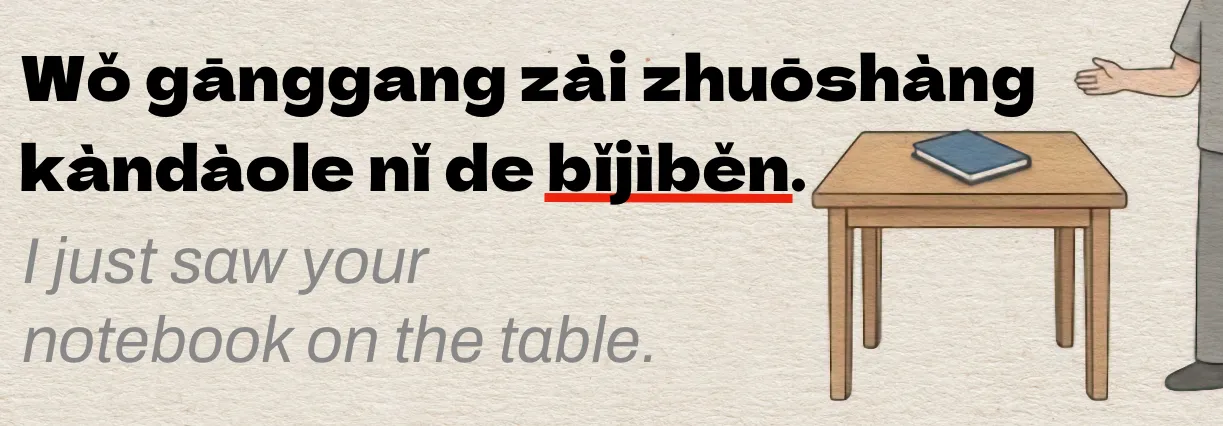
Wǒ gānggang zài zhuōshàng kàndàole nǐ de bǐjìběn.
我刚刚在桌上看到了你的笔记本。
I just saw your notebook on the table.
The underlying Chinese example sentences above are taken from Mandarin Corner‘s comprehensive HSK 3.0 Standard Level 3 Course. Pīnyīn transcription by Alfons Grabher, following GB/T 16159-2012. English translations by Google Translate.
This kind of incoherent, simplified pedagogical language is standard throughout the language-learning landscape. But the problem isn’t necessarily with the people creating them. The problem is systemic: an underlying pedagogy that has become so familiar that few people think to question it.
The trouble is not the teacher. The trouble is the landscape.
The negative effects of spending years working with simplified pedagogical language aren’t limited to students. They can affect teachers, too.
For example, have a look at this candid exchange between three experienced and well-known Chinese language teachers. They’re discussing something rather unexpected: how working for extended periods in an environment where they constantly have to simplify their language can affect their own linguistic expression.
Transcript: What Chinese Teachers Say About Simplified Language
The work environment in New Zealand sounds truly appealing—I could easily imagine staying there for a decade. But tell me, Cherry, what eventually led you to decide to leave?
Well, even though I’ve been moving around quite a bit working as a Chinese language teacher, I’ve come to realize that my own teaching skills and experience aren’t as solid as they could be. I felt it was necessary to return to the environment back in China.
3
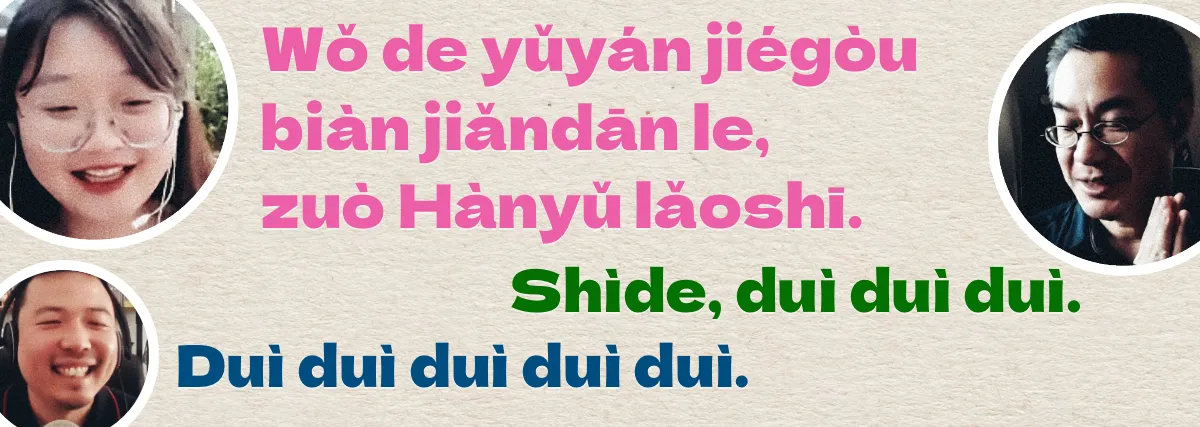
Dì-yī gè shì, wǒ fāxiàn wǒ zài nàbiān jiǔ le, wǒ de yǔyán jiégòu biàn jiǎndān le, zuò Hànyǔ lǎoshī. Nǐmen yīnggāi yě yǒu tǐhuì ba?
第一个是,我发现我在那边久了,我的语言结构变简单了,做汉语老师,你们应该也有体会吧?
For one thing, I noticed that after spending so much time there, my own language structure—the way I speak—has become much simpler. You’ve probably experienced this too, as Chinese teachers, right?
4
(Richard) Yǒu. (Ben) Duì duì duì, wǒ zhè dànǎo yǒudiǎn chídùn de gǎnjué, yīnwèi yǒushíhou yào hěn màn de shuōhuà, bù néng yòng tài nán de cí.
有,对对对,我这大脑有点迟钝的感觉,因为有时候要很慢的说话,不能用太难的词。
Exactly! My brain feels a bit sluggish; I’ve gotten into the habit of speaking very slowly and avoiding any complex vocabulary.
5
(Cherry) Duì! (Richard) Bènshū, shàng zhè gè xuéshēng de kè jiǔ le, gēn wǒmen lù »Dàshū Zhōngwén«, tā de yǔyán céngcì jiù huì biànde bǐjiào dī yī diǎn.
对,这个变书,上这个学生的课久了,跟我们录大叔中文,他的语言层次就会变得比较低一点。
Right—when you spend a long time teaching students—like the guys we feature on our “Uncle Chinese” (Dashu Zhongwen) recordings—your own level of language usage tends to drop a bit.
6
(Ben) Wǒ gēnbùshàng, duì, yīnwèi wǒ xiànzài gēn wǒ de nà gè mǔyǔzhě péngyou liáotiān, wǒ jiù fāxiàn wǒ gēnbùshàng tāmen yǔsù le.
我跟不上,对,因为我现在跟我的那个母语者朋友聊天,我就发现我跟不上他们语速了。
I can’t keep up anymore! When I chat with native-speaker friends, I find I can’t keep pace with how fast they talk.
Because of that, I’d sometimes stumble or get stuck when teaching advanced-level students. I realized I needed to return to a native-language environment. Also—and this is the second reason—there’s a lot of room for rapid professional growth for Chinese teachers here.
During the year I spent in Shanghai, I realized that while the institutions can be quite cutthroat—and they might not always treat their teachers very well—you have to admit that their systems are excellent and foster very fast development. I wanted to come back and put myself to the test in that kind of demanding environment. So, that’s why I returned.
Original transcript (Chinese characters) by YouTube, Pīnyīn transcription by Alfons Grabher, following GB/T 16159-2012. English translations by Google Translate.
Think about that. These are experienced native Chinese teachers, and they’re describing how years of simplifying their language have affected their own speech. Cherry says her sentence structures became so simple, that she needs to leave the country she‘s living in, and return to China to brush up her Chinese speaking skills. Ben admits his brain is feeling sluggish due to often speaking very slowly and avoiding any complex vocabulary. They even talk about struggling to participate in ordinary conversations among native speakers.
If this is what native speakers notice about themselves, as a result of teaching through simplified pedagogical language, what does this mean for learners?
Vocabulary-based example sentences give you nothing to care about.
Textbook sentences fail because they lack a likeable protagonist, a narrative, tension, subtext, and consequence. Every line is an isolated, sterile proof of grammar, bland, pointless, it’s not even funny.
Even the most carefully crafted HSK preparation materials rarely convey the beauty, richness, and expressive possibilities of the Chinese language. Instead, learners encounter an endless succession of disconnected sentences, forgettable dialogues, and comprehension questions that reduce language to the mechanical retrieval of information.
There is nothing wrong with the ordinary or the absurd, great literature has made entire worlds out of both. The trouble is that here, neither seems to serve any purpose beyond the exercise itself. Consider this example:
HSK Level 3 — A Real Listening Comprehension Example
Listening passage:
Jīntiān wǒ xiǎng zǎodiǎn huíjiā, kànle kàn shǒubiǎo cái wǔ diǎn, guòle yīhuìr zài kàn biǎo, háishi wǔ diǎn. Wǒ zhè cái fāxiàn wǒ de shǒubiǎo bù zǒu le. Today I wanted to go home early. I checked my watch and it was only five o’clock. A little later, I checked again. Still five o’clock. Only then did I realize my watch had stopped.
Statement to evaluate:
Nà kuài shǒubiǎo bù shì tā de. That watch isn’t his.
Answer:
True or False?
Perhaps the most troubling part is how accustomed many students have become to all this. After years of working through such exercises, they may no longer expect language-learning materials to be interesting, moving, or beautiful. They may not even recognize what is missing, even when someone draws their attention to it. Students may have lost not only the expectation of something better, but even the ability to notice the loss.
I think we could do considerably better.
For example, we could turn the ten example sentences from above into a piece of literary fiction. We might not succeed in imitating Raymond Carver, but we can borrow the qualities that make stories work: well-crafted prose, domestic details, some tension, loneliness, small disappointments, and the occasional flash of unexpected tenderness.
Let’s try something, let’s write some real fiction:
I said, “Mom says I’m the smartest kid in my class.” I didn’t know whether Dad had heard me. He said nothing. He just went on reading his newspaper. I repeated, “She says that of all the children in my class, I’m the smartest.” Dad didn’t even look up, he just gave a distracted ‘mm’.
5
Hěn duō nián guòqù le. Xiànzài wǒ zhù zài lìng yī gè chéngshì. Wǒ de línjū shì yī wèi xìng Wáng de yīshēng, jiù zhù zài gébì.
很多年过去了。现在我住在另一个城市。我的邻居是一位姓王的医生,就住在隔壁。
Many years passed. Now I live in another city. My neighbor is a doctor named Wang. She lives right next door.
6
Wáng āyí shuōhuà hěn qīng. Tā de àirén yě shì yīshēng, jǐ nián qián qùshì le.
王阿姨说话很轻。她的爱人也是医生,几年前去世了。
Auntie Wang speaks softly. Her husband was a doctor too. He died several years ago.
7
Yǒu yī cì, tā gàosu wǒ, tā zhàngfu yǐqián xǐhuan jì bǐjì. “Shénme dōu jì,” tā shuō, “lián tiānqì yě jì.”
有一次,她告诉我,她丈夫以前喜欢记笔记。“什么都记,”她说,“连天气也记。”
Once she told me her husband liked keeping notes. “He wrote everything down,” she said. “Even the weather.”
Finally, I reached for it and opened it to the first page. There was a date, the weather, and one sentence: “Today I don’t know what to do.” There was nothing written beneath it.
12
Yuánlái, zuòle dà bàn bèizi yīshēng de rén, yě huì yǒu xiǎngbuchū bànfǎ de shíhou.
原来,做了大半辈子医生的人,也会有想不出办法的时候。
It turns out that people who have been doctors for most of their lives sometimes don’t know what to do.
I sat there a little longer. It was quiet. I stood up and left the office.
Of course, this little story is fabricated too. But it already gives us something to think about, something to remember, and perhaps even something to feel.
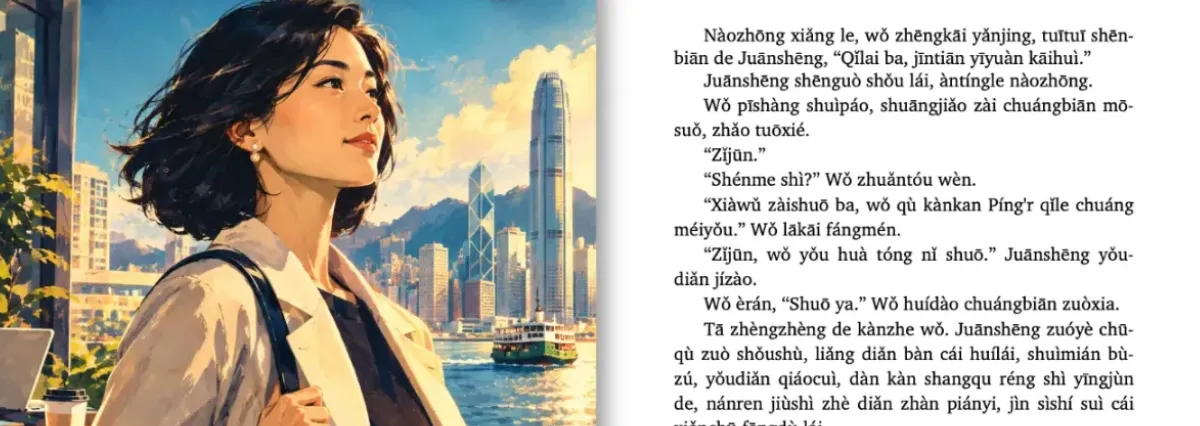
But imagine what we might find in real literature. Consider the opening sentences of the book《我的前半生》 (Wǒ de qiánbànshēng), by Hong Kong writer 亦舒 (Yì Shū):
Real literature: The First Half of My Life by Yì Shū
24
1
Nàozhōng xiǎng le, wǒ zhēngkāi yǎnjing, tuītuī shēnbiān de Juānshēng, “Qǐlai ba, jīntiān yīyuàn kāihuì.”
闹钟响了,我睁开眼睛,推推身边的涓生,“起来吧,今天医院开会。”
The alarm went off. I opened my eyes and nudged Juansheng, who was lying beside me. “Time to get up—there’s a meeting at the hospital today.”
He stared at me, lost in thought. Juansheng had been out performing surgery the night before and didn’t get back until 2:30 a.m. He looked a bit haggard from the lack of sleep, yet he remained handsome—that’s the advantage men have; they often don’t truly come into their own, with a sense of poise, until they’re pushing forty.
10
Wǒ qīngqīng wèn: “Shuō shénme?”
我轻轻问:“说什么?”
“What is it?” I asked softly.
11
Tā tànkǒuqì, “Wǒ zhōngwǔ huílái zàishuō ba.”
他叹口气,“我中午回来再说吧。”
He let out a sigh. “I’ll tell you when I get back at noon.”
12
Wǒ xiào le. Wǒ lākāi mén zǒudào Píng'r nàli qù.
我笑了。我拉开门走到平儿那里去。
I smiled, then opened the door and headed toward Ping’er’s room.
13
Bā suì de Píng'r jiāng zhěng zhāng liǎn mái zài zhěntou lǐ shúshuì, tā de tóu zhǎngde bǐ qítā de háizi dōu dà, rén bǐ qítā de háizi zhìqì, rénjia lǎosān-lǎosì shénme dōu dǒng, tā què xiàng Pángǔ chū kāi tiāndì bān hùndùn, zhěngtiān pěngláo mànhuàshū.
Eight-year-old Ping’er was fast asleep, his entire face buried in his pillow. His head was larger than most children’s, and he seemed far more childlike, too. While other kids his age—even those with older siblings—seemed to know everything, Ping’er remained in a state of pure, unformed innocence, spending his days glued to his comic books.
I shook him awake—a daily ritual to get him ready for school. Thank goodness I only have one son; if I had more, I’d spend hours every morning just trying to get them out of bed.
15
Shí'èr suì de Ān'r tàntóu jìnlai, “Māma, nǐ zài zhèr ma? Wǒ yǒushì zhǎo nǐ.” Tā kànkan zài chuáng shàng yī wú de dìdi, mǎshàng zhòu shàng méitóu, “Dōu shì māma guànchéng zhèyàng de, xiàcì bù qǐchuáng, jiù yīnggāi bǎ tā rēngjìn lěngshuǐ lǐ.”
Twelve-year-old An’er poked her head in. “Mom? Are you in here? I need to talk to you.” She glanced at her brother, who was mumbling in his sleep, and immediately frowned. “It’s all because you spoil him, Mom! Next time he won’t get up, you should just toss him into a tub of cold water.”
16
Wǒ xiàozhe bǎ Píng'r lā qǐlai, nà xiǎozi de yuán nǎodai dàochù huàng, kě'ài de bù xiànghuà, wǒ hěnhěn wěn tā de liǎn, bǎ tā jiāo zài yōngrén Āpíng de shǒulǐ.
我笑着把平儿拉起来,那小子的圆脑袋到处晃,可爱得不像话,我狠狠吻他的脸,把他交在佣人阿萍的手里。
Laughing, I pulled Ping’er up. His round head bobbed about—he was impossibly adorable. I planted a big kiss on his cheek and handed him over to A-Ping, the domestic helper.
17
Ān'r kànbùshùnyǎn, tā shuō: “Māma jiǎrú zài zhèyàng, jiānglái tā jiù biànchéng niángniangqiāng.”
安儿看不顺眼,她说:“妈妈假如再这样,将来他就变成娘娘腔。”
An’er didn’t like what she saw. “If Mom keeps this up,” she remarked, “he’s going to turn into a sissy.”
I followed her into her room, where she slipped off her robe so I could see.
22
Ān'r de xiōngbù fāyù de shízai hěn kuài, gǔ péngpeng de yǎnrán yǐ yǒu shàonǚ zhī fēng, wǒ shēnshǒu àn yī àn tā de bèilěi.
安儿的胸部发育得实在很快,鼓蓬蓬的俨然已有少女之风,我伸手按一按她的蓓蕾。
An’er’s breasts were developing remarkably fast; they were already full and rounded, giving her the distinct air of a young woman. I reached out and pressed lightly on one of her budding breasts.
“Meet me after school in front of that place we went to last time—we’ll get you some new ones.”
What makes real literature so effective is not simply that it tells a story, told by a master storyteller. It’s that the language has a certain social and psychological density. People have bodies, habits, vanity, impatience, desires, little cruelties, peculiarities. They interrupt one another. They have things to do. They are occasionally ridiculous.
And, crucially, the narrator doesn’t seem to be teaching us anything. We just learn about the people and their stories, and as a side effect we learn their language. That’s the magic. Or, as the psychotherapist Yán Yìjiā (严艺家) put it: