Read Mandarin From Day One.
Fall in love with the language, learn vocabulary, master pronunciation, and enjoy modern Chinese novels written 100% in official Hànyǔ Pīnyīn.
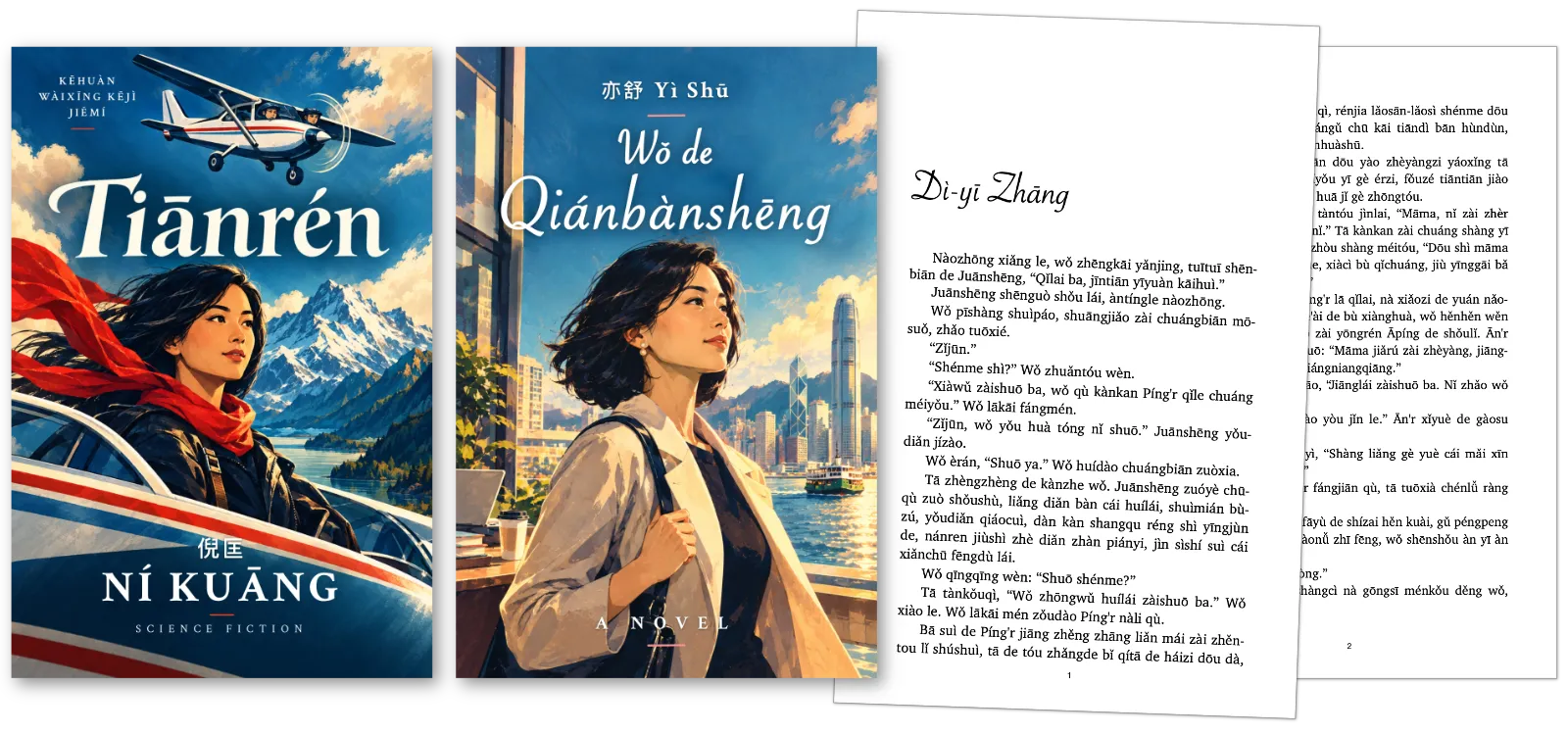
What if… modern Chinese novels could be read entirely in Hànyǔ Pīnyīn, and found in bookstores alongside the world’s great literature?
Bypass the Character Barrier
A Delightful Path for Self-Directed Learners
The Pīnyīn Explorer Method is an original set of tools and pedagogical concepts for adults ready to learn modern Mandarin through its official alphabetic script, Hànyǔ Pīnyīn.
With Mandarin, you face a thousand hours of character study before you can confidently read written text. Traditional methods center their curricula on mastering 2,500 to 3,500 individual characters, stacking up tens of thousands of character-related learning targets long before you ever get the chance to read real literature or authentic stories.
The Pīnyīn Explorer Method helps you bypass this massive first barrier so you can dive directly into pronunciation, vocabulary, and real reading.
Words Carry Meaning
You bring complex ideas, professional expertise, and a distinct sense of humor to the table. Yet many textbooks infantilize adult learners, reducing modern Mandarin to fabricated, paint-by-numbers scripts:
- 图书馆在哪儿? Túshūguǎn zài nǎr? — Where is the library?
- 你家有几口人? Nǐ jiā yǒu jǐ kǒu rén? — How many people are in your family?
- 我每天八点去学校。 Wǒ měitiān bā diǎn qù xuéxiào. — I go to school at eight o’clock every day.
These sentences aren’t drawn from real life—actual conversations, literature, or the way people really speak and write. They are fabricated for the textbook, constructed to illustrate a particular grammar point or vocabulary item.
The Chinese-language literary world is vast, vibrant, and remarkably brilliant.
You don’t need to put up with sterile textbook scripts. From Lǔ Xùn and the emergence of modern vernacular literature in the 1920s, through generations of literary titans, to today’s extraordinarily prolific world of novels, web fiction, and contemporary writing, the Chinese-language literary world is vast, vibrant, and remarkably brilliant. Just to put that scale into perspective, the Chinese Writers Association reported that China’s online-literature catalog exceeded 33 million works by the end of 2025. The barrier is almost entirely linguistic access.
By treating Hànyǔ Pīnyīn as a standalone orthography, you strip away the character drag and unlock immediate access to modern Chinese literature, right from the start of your study journey.
Your 3-Step Journey
The pathway of the Pīnyīn Explorer Method
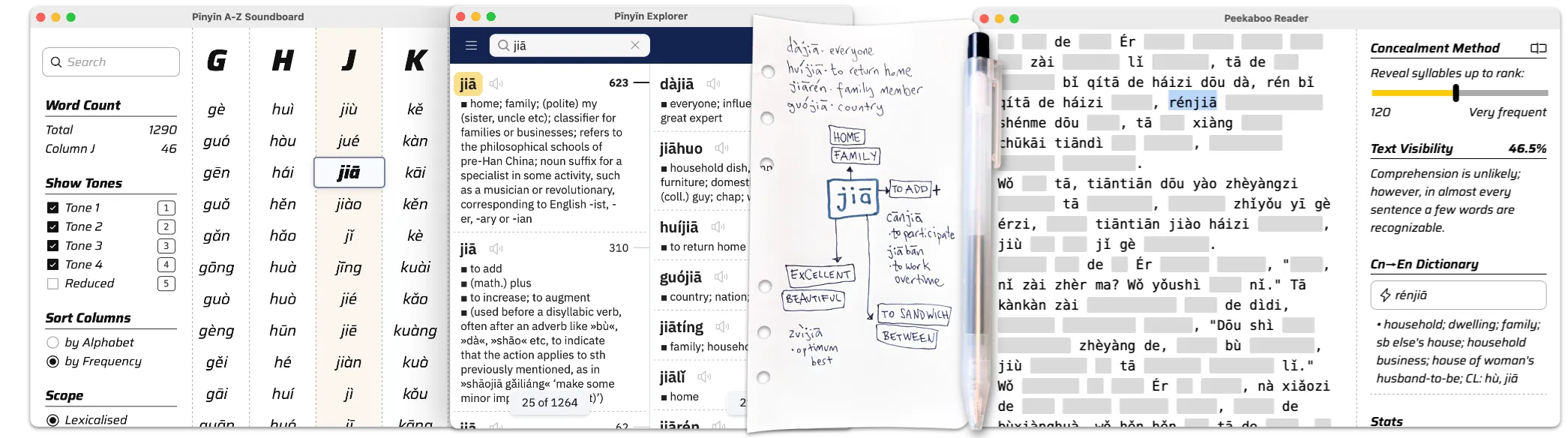
Pronunciation → Vocabulary → Reading
1. Pronunciation & Sound Immersion
Start with the complete monosyllabic, phonotactic, and morphemic inventory on the A-Z Soundboard. Audition every dictionary-backed base word before concerning yourself with meaning. Click, listen, shadow, and group words to build an intuitive phonological foundation and eliminate tone confusion from day one.
2. Master the 365 Core Anchor Words
Modern Mandarin isn’t built on long, winding words—it’s built on a compact core of monosyllabic building blocks. Instead of memorizing thousands of isolated terms, you master 365 core anchor words that branch out into the rest of the lexicon. Play and study with Pīnyīn Explorer’s built-in Flashcard and Quiz system—the ultimate high-leverage shortcut to modern Mandarin.
3. Transition into Authentic Reading
Skip graded readers. Drop real podcast transcripts, news articles, and native media directly into the Peekaboo Reader. Follow a progression from recognizing basic punctuation and high-frequency anchor words to reading native text out loud.
The Pīnyīn Explorer Toolkit
The Apps and Exercises with Pen & Paper
Pīnyīn A-Z Soundboard — Interactive Pīnyīn Chart with Audio
Speak Mandarin from day one. The complete monosyllabic, phonotactic, and morphemic inventory of modern Mandarin. The ultimate Pīnyīn chart featuring 2,000+ native recordings, pitch visualizer, keyboard navigation, autoplay, as well as extensive search, sorting, and filtering options.
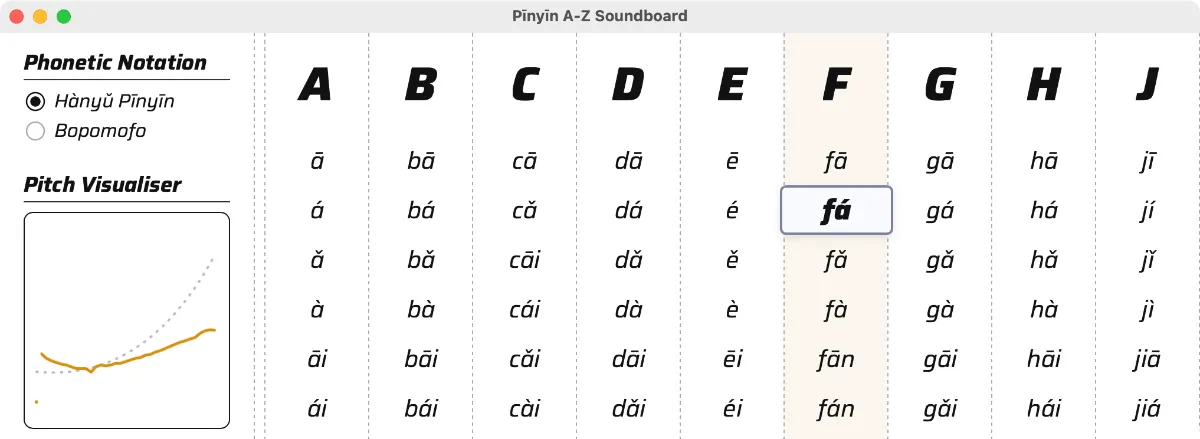
The Pīnyīn A-Z Soundboard shows real words, not syllables split up by initials and finals. This means, you’re working with real words, all words can be found in the dictionary.
Pīnyīn Explorer — Pīnyīn-First Chinese-English Dictionary & Flashcards
A thoughtfully designed Pīnyīn-first Chinese–English dictionary for exploring the structure of Mandarin vocabulary. Search for a word in Pīnyīn (or pin1yin1), and deep dive into its meanings and compounds.
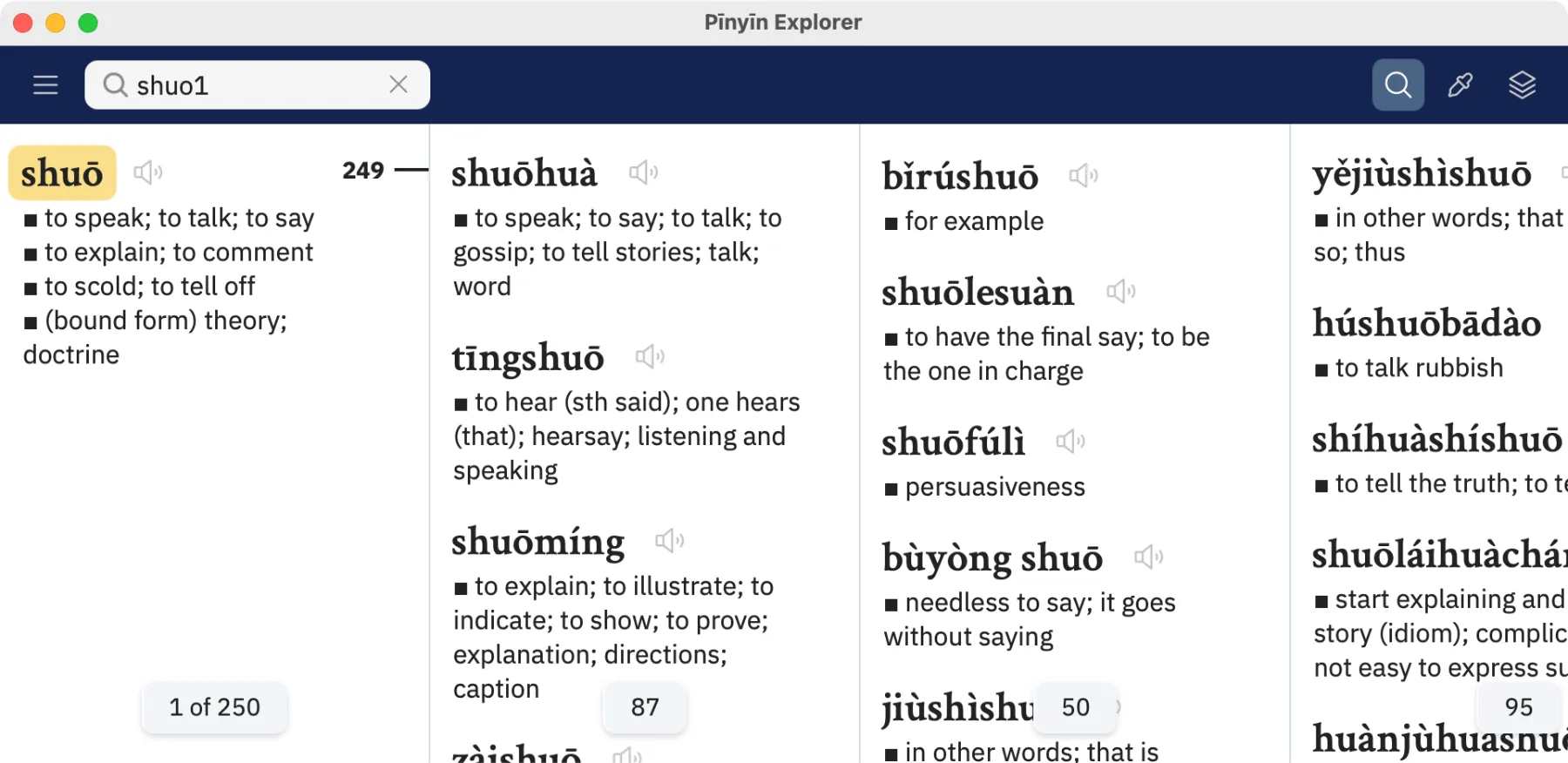
Pīnyīn Explorer includes 114,000+ entries adapted for Pīnyīn and general audiences. It has cascading multi-column views, and adjustable dictionary scopes. You can adjust which words the dictionary will show, for example, show only words that are in the HSK 3.0 corpus, like a dedicated HSK 3.0 dictionary, or show only words that fall within your selected frequency-range.
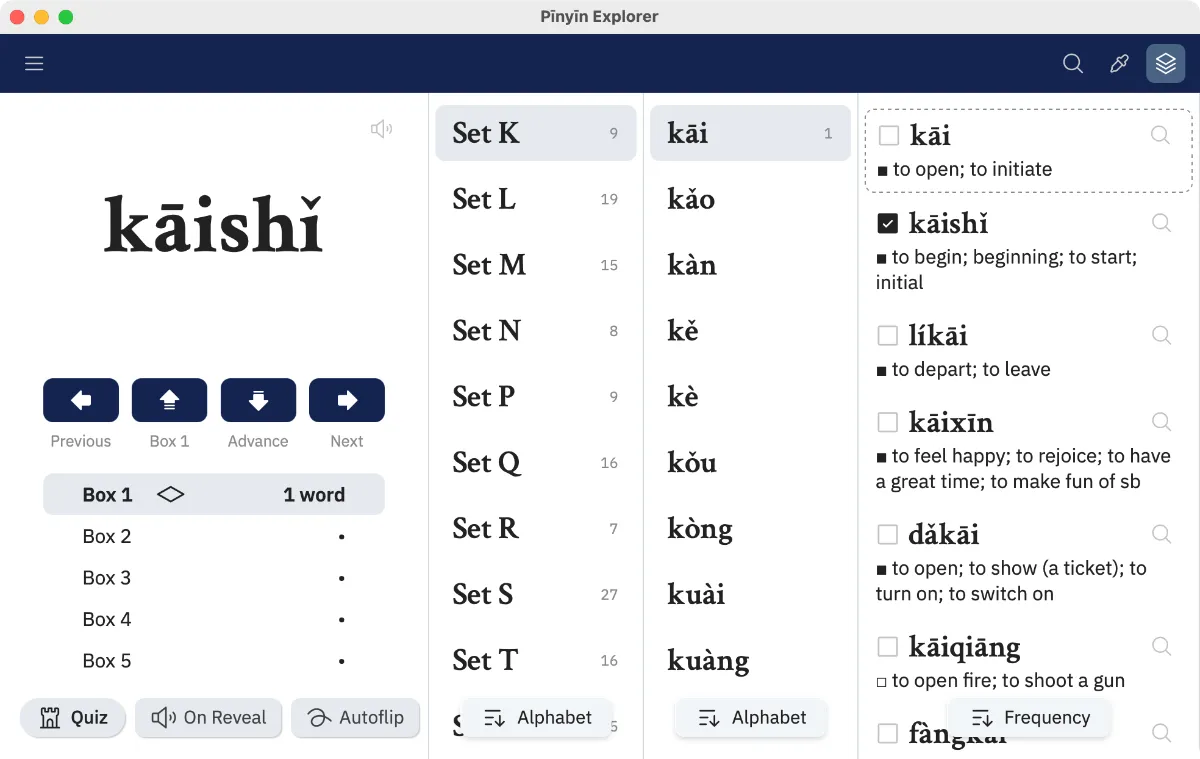
Next to the comprehensive inventory, Pīnyīn Explorer features a classic 5-box Leitner flashcard system, which includes a quiz system with pedagogically structured learning progressions with extra carefully curated 365 core anchor words.
Pīnyīn Explorer is the definitive Mandarin Pīnyīn to English dictionary and flashcard app for casual readers, ambitious students, and serious scholars alike.
Peekaboo Reader — Chinese-to-Pīnyīn Text Converter & Reader
A plain-text reading environment with adjustable Pīnyīn visibility. You set your level, and are only presented with words and phrases you should know. You’re not distracted (or tempted) by words and phrases that are still beyond your level.
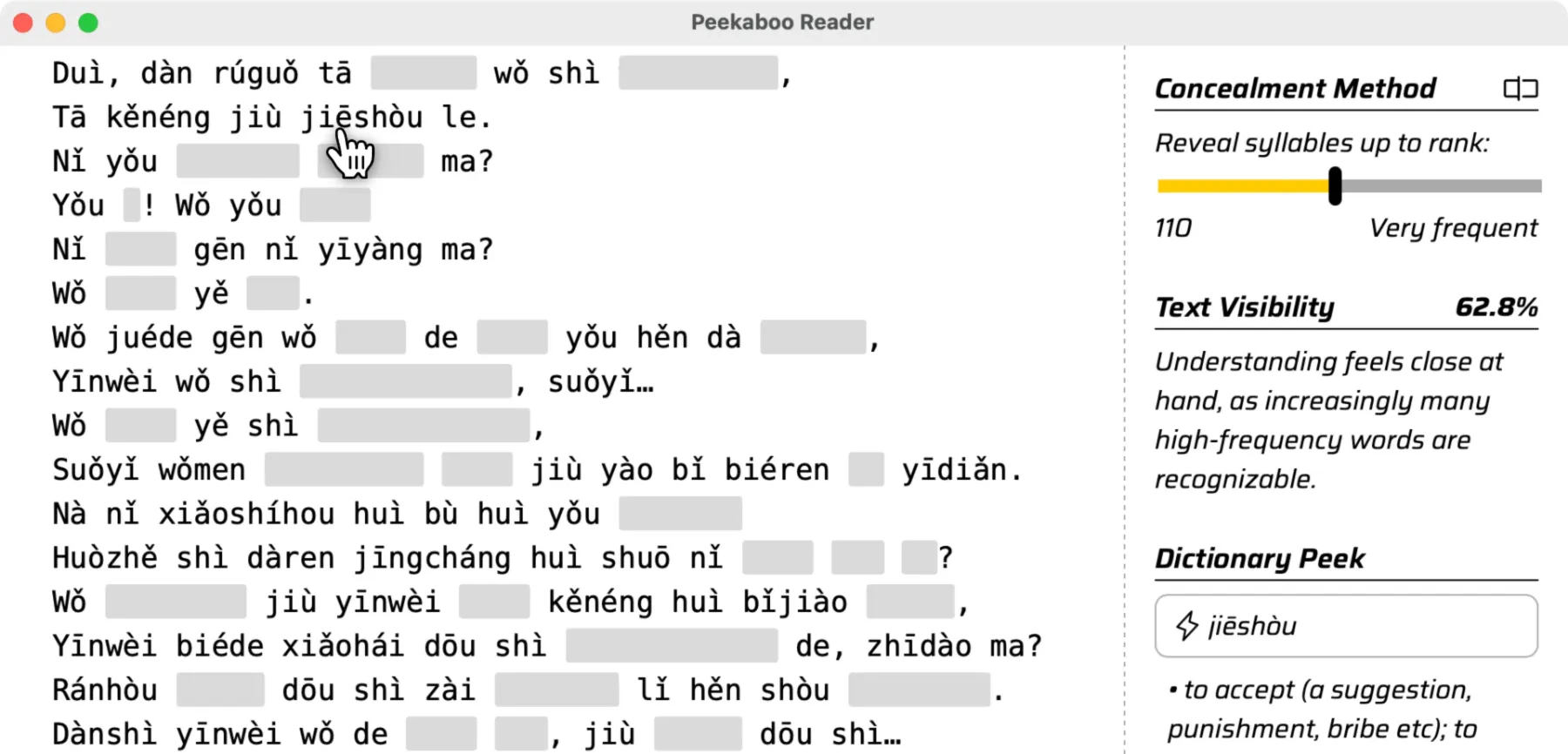
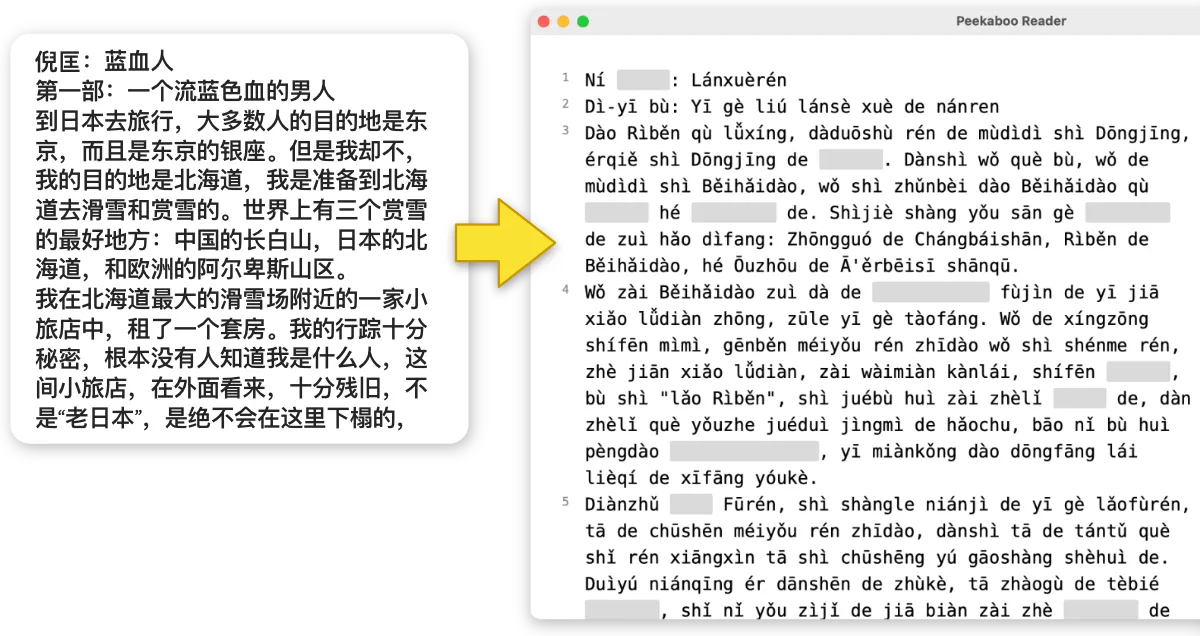
Paste text written in Chinese characters directly into the Peekaboo Reader and the built-in engine automatically converts text into Pīnyīn sentences following official GB/T 16159-2012 orthographic standards. Podcast and TV drama subtitles, web novels, sci-fi, romance, wuxia, lifestyle stories… drop in anything you actually want to read.
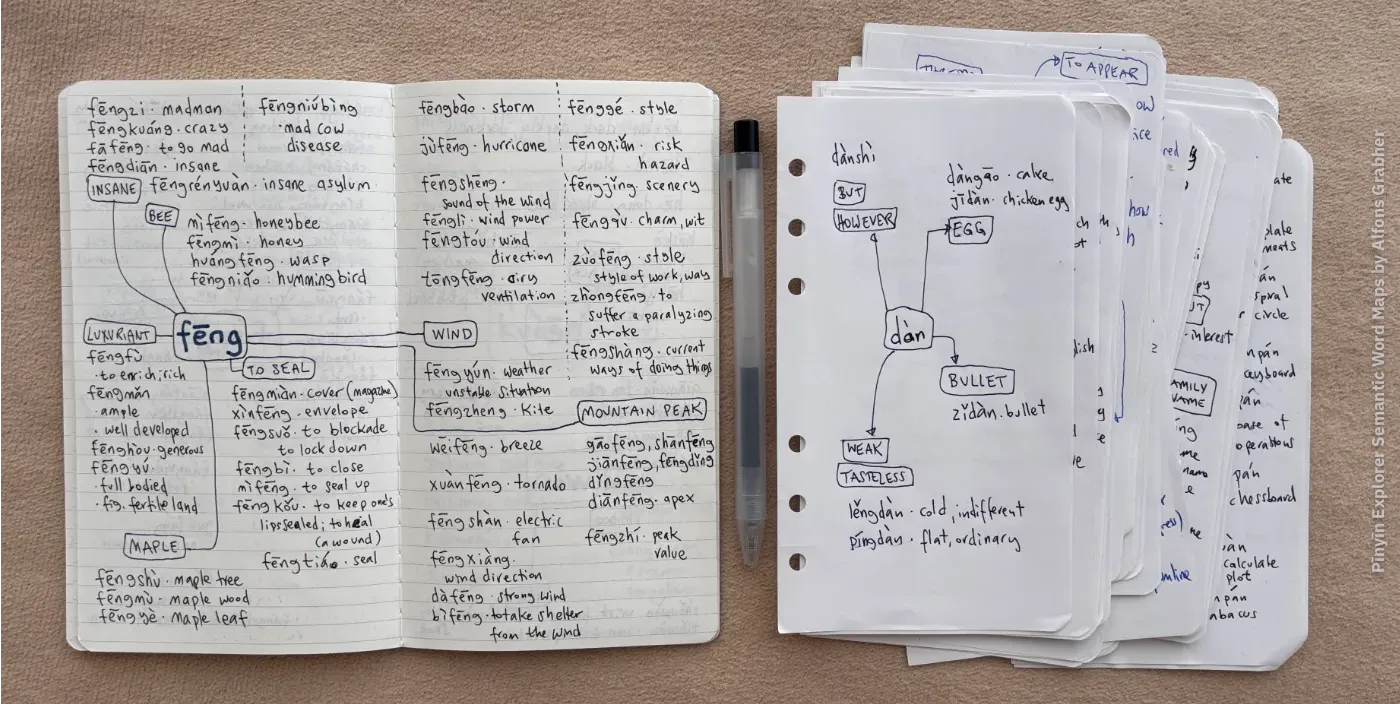
Semantic Word Maps — A Hands-On Mandarin Vocabulary Method
Learning vocabulary shouldn’t happen entirely behind a screen. The hand-drawn maps of the Pīnyīn Explorer Method take you off the computer and onto paper to build a personal lexicon. You place a Pīnyīn anchor word at the center of a page, map its primary senses like a mind map, and add compound words of your own choice directly from the dictionary.
Instead of memorizing generic textbook lists, you select the exact words that are meaningful, useful, and fun to you—practicing proper orthographic spelling and engaging with the language on your own terms.

Read the Methodology & Manifesto for a deeper dive into the Pīnyīn Explorer pedagogical framework, an overview of its products, and a brief history of global script transitions.
Immediate Access to Modern Literature
Read real Chinese from day one
Consider the following sentence. Even after many months of studying Mandarin, an HSK 4–5 learner would not be expected to read it comfortably in Hànzì:
Now look at the exact same sentence in official Hànyǔ Pīnyīn below. The character wall is gone. You can parse the text immediately. Perfecting your tones will take a few weeks of deliberate practice—and then you can focus on building vocabulary and learning the language (which will be hard enough even without having to learn Chinese characters):
For a beginner or intermediate learner of Mandarin, the bookstore isn’t off-limits—the characters are. The moment you remove that barrier, modern Chinese literature is yours to read.
Read more books. Read to escape. Read to understand. Read to know yourself.
What if you could dive straight into the original Chinese of Liu Cixin’s masterpiece of dark cosmic sci-fi—The Three-Body Problem—grappling with the vocabulary, unspooling the syntax, and savoring the cadence of the original prose—without spending five years memorizing characters first?

Wāng Miǎo juéde, lái zhǎo tā de zhè sì gè rén shì yī gè qíguài de zǔhé: liǎng míng jǐngchá hé liǎng míng jūnrén, rúguǒ nà liǎng gè jūnrén shì wǔjǐng hái suàn zhèngcháng, dàn zhè shì liǎng míng lùjūn jūnguān.
“Qǐng bù yào zài wǒ jiā lǐ chōuyān.” Wāng Miǎo lánzhùle tā.
“Nà jiù zài lóudào lǐ shuō ba.” Shǐ Qiáng shuōzhe, shēnshēn de xīle yī dàkǒu, shǒu zhōng de yān jīhū rán xiàqù yībàn.
Or perhaps your tastes lean more toward the fast-paced, dialogue-rich world of modern Chinese pop culture? What if you could read Mòbǎofēibǎo’s romance hit Honey Stewed Squid (Mìzhī Dùn Yóuyú)—experiencing the playful inner monologues and authentic conversational flow—without getting read-blocked by a wall of characters?

Xiǎng zhīdào shénme jiào yījiàn-zhōngqíng ma?
Jiùshì zhè yī miǎo. Jiùshì xiànzài, tā duì miànqián gézhe yī gè guìtái de nánrén yījiàn-zhōngqíng le.
Tóng Nián dītóu, shǒuzhǐ zài jiànpán shàng pīli-pālā de qiāo ya qiāo, míngmíng xiǎngyào jiànlì yī gè xīn mìmǎ, kě, nǎozi lǐ què zài pīnmìng de huíxiǎng, qián yī miǎo, tā duì zìjǐ shuō “bāoyè” liǎng gè zì de shíhòu, zìjǐ jiūjìng yǒu méiyǒu duì tā xiào? Hǎoxiàng zuǐjiǎo yǒu shàngyáng? Háishì chúndāi?
Whether it’s the foundational social commentary of Lǔ Xùn (鲁迅), mind-blowing sci-fi, or laugh-out-loud romance, treating Hànyǔ Pīnyīn as an independent orthography gives you countless great works of modern Chinese literature to explore from day one.
Using Hànyǔ Pīnyīn to read, write, and speak modern Mandarin as a second-language learner, the question is not, “Is this possible?” That question has already been answered. The question is, “Can you give yourself permission?”
Start Exploring Today
Download all three apps: Pīnyīn A-Z Soundboard, Pīnyīn Explorer, and Pīnyīn Peekaboo Reader—and take your direct path to fluent Mandarin.